
Comprehensive Guide to Increasing MFI (Melt Flow Index) with Processing Aid Masterbatch
Table of contents
In the world of polymer manufacturing, there has always been a major trade-off: choosing between stronger resins with high molecular weight (and low MFI) or weaker resins with easier processability (and high MFI). But what if there were a way to benefit from the strength of a low-MFI polymer while simultaneously improving its flowability in your extruder? This is precisely the advantage that Polymer Processing Aid (PPA) masterbatch offers. In this article, we specializedly explore the Melt Flow Index (MFI) and the key role of processing aids in optimizing it.
What is MFI or Melt Flow Index? The Melt Flow Index (MFI) is a measure of the fluidity or viscosity of a polymer in its molten state. Simply put, MFI indicates how easily a polymer flows under standard temperature and pressure conditions.
-
Low MFI: Indicates higher molecular weight, longer polymer chains, and consequently better mechanical properties (such as tensile strength and tear resistance). However, processing these polymers is more difficult.
-
High MFI: Indicates lower molecular weight and easier flowability, but usually results in weaker mechanical properties.
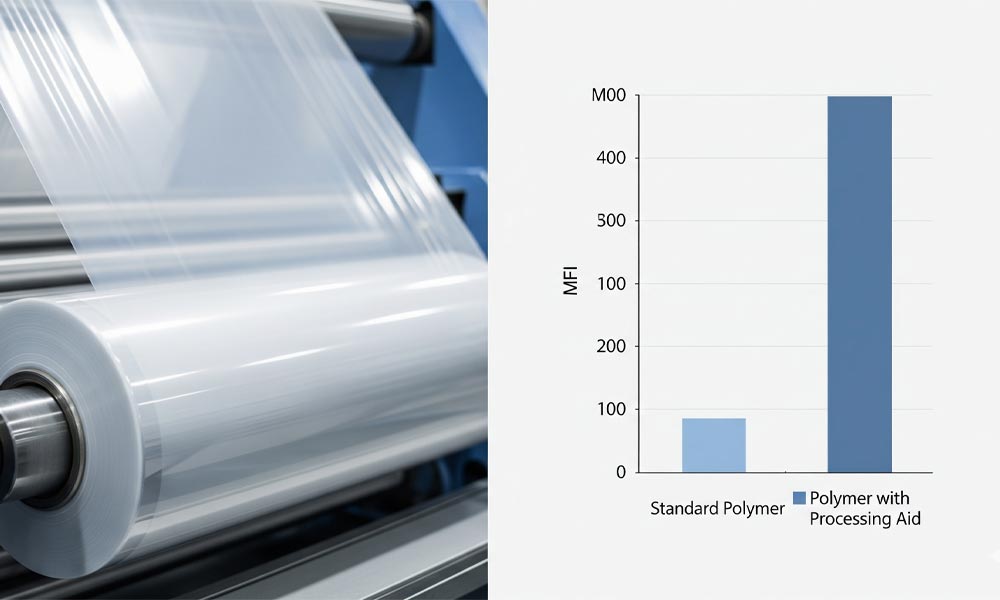
The Key Role of Processing Aid: Improving Flowability Without Sacrificing Properties The main challenge in using low-MFI resins is their high friction against the metal surfaces of the extruder, leading to increased head pressure, higher processing temperatures, and issues like melt fracture. This is where the performance of PPA masterbatch shines. By forming a lubricated, non-stick coating on the die walls and screw, this additive dramatically reduces flow resistance. As a result, the molten low-MFI polymer moves through the machinery much easier and under lower pressure—as if its MFI had been increased. This advantage allows you to get the best of both worlds. As noted in our product technical datasheet, a key benefit is enabling the use of resins with lower Melt Flow Index (MFI).
Commercial Benefits of Improving Flowability with PPA
-
Utilizing Superior Raw Materials: You can process stronger polymer grades (with lower MFI) that were previously difficult to process, leading to higher quality end-products.
-
Increased Production Output: By reducing pressure and improving flow, you can boost line speed without compromising product quality.
-
Lower Processing Temperatures: Enhanced melt flow allows you to reduce extrusion temperatures, saving energy and preventing thermal degradation of the polymer.
-
Enhanced Mechanical Properties: By incorporating low-MFI resins, your final product achieves superior mechanical characteristics, such as higher elongation at break.
Using low-MFI resins that were previously challenging to process allows for the production of higher quality goods. This is particularly vital for specialized applications like PVC pipe and profile manufacturing.
Polymer Processing Aid (PPA) masterbatch is not merely a simple lubricant; it is a powerful engineering tool for formulators and production managers. By optimizing flowability and mimicking an effective increase in MFI, this product allows you to overcome processing constraints and produce stronger, higher-quality products at lower operational costs. Contact us for technical consultation on optimizing your production line and obtaining current pricing for Kavosh Polymer processing aid masterbatches.